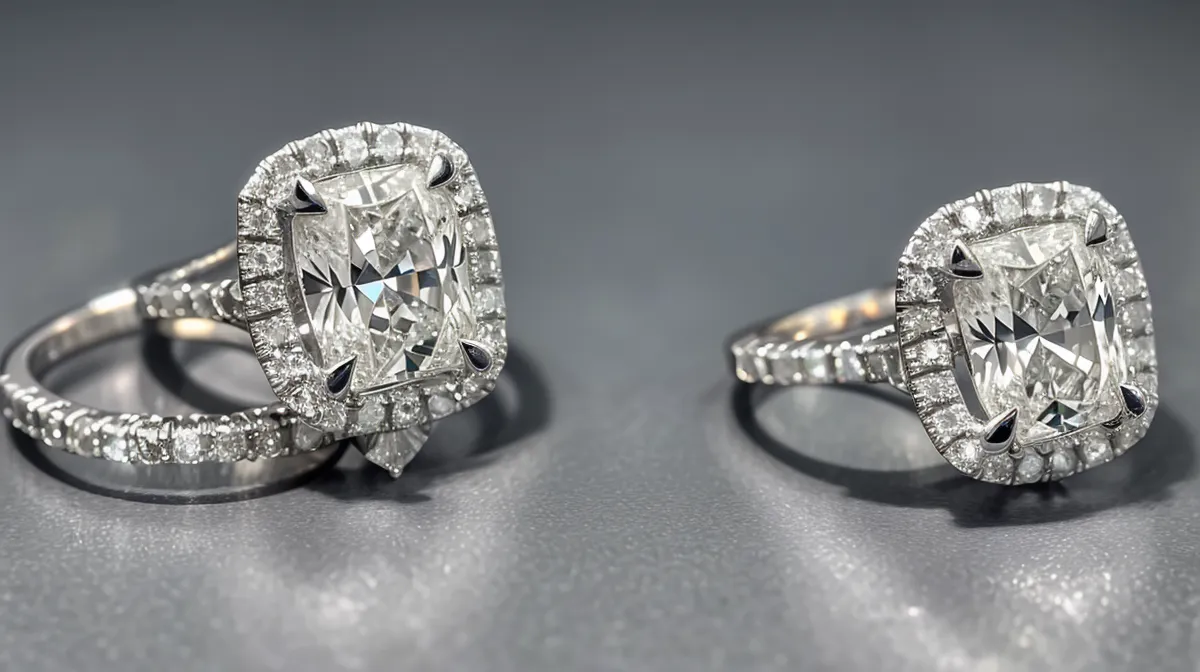
The question nobody says out loud when a Kay Jewelers salesperson slides a credit application across the case is how much you would pay, in money you don't have yet, just to avoid an awkward pause at the counter. It's the one sitting underneath every engagement ring financing decision I've watched a friend make. I've become the person friends call before they sign anything — the one who reads jewelry credit card terms out loud at brunch and asks the questions that kill the mood. Ring shopping advice from me usually starts with some version of that same unanswered question, and it doesn't get easier the more times I answer it.
Most recently it was a friend who does improv most Thursday nights at Theatre 99 downtown — completely unflappable on stage, frozen solid in front of a Kay checkout screen with a countdown ticking on the promotional financing offer. We ended up walking the length of The Battery instead of finishing that conversation inside the store, because she needed air and I needed to stop standing under fluorescent lighting.
My answer, most of the time, is: it depends entirely on whether you can treat a zero percent window like a hard deadline instead of a grace period. Miss that distinction and the "free" financing turns into the most expensive way to buy a ring in the building.
That checkout screen is built to feel like a countdown you can't afford to lose. The offer promises no interest if the balance clears within a set window, and it reads like a lifeline when the price tag looks like a down payment on something much bigger. I've spent enough evenings picking apart credit card agreements to know that "zero interest" rarely means what it sounds like — it's marketing dressed up as generosity. I vet it the same way I'd vet a used car loan or an apartment lease renewal: read every line before signing anything, because that's exactly what this is. Kay isn't one shop deciding to be generous; it's a single storefront inside Signet Jewelers, a company running close to 2,800 stores, and the financing program is built at that scale, never at the counter.
Recognizing the Kay Jewelers Financing Pitch
Every mall counter runs some version of the same script. The lighting seems to dim half a stop the moment you lean in with a loupe, like the diamond's being given a chance to perform. Near the financing desk the air always feels a little thick, close and slightly stale, the kind of air that makes signing something feel like the fastest way back outside. There's a sound to it too — the click of a velvet box snapping shut right after you've admitted you love the ring, just before the credit application lands on the counter. Closing that box is the move. Without saying it, it tells you the ring is basically already yours, and all that's left is paperwork.
During my own hunt for a ring, I tried to shortcut the research by asking a friend-of-a-friend who worked in fine jewelry what she'd recommend. That backfired — she turned out to be in sales, and every "recommendation" pointed straight back to whatever her store happened to be pushing that month. It taught me fast that advice from inside the industry deserves the same skepticism as the sales pitch itself, financing included.
What "Deferred Interest" Really Costs You
Kay's standard financing runs on deferred interest, in windows of six, twelve, or eighteen months. Paid off in full before the window closes, it really is interest-free. Miss it by even a sliver and the math flips hard, because the interest isn't calculated on whatever balance is left — it gets backdated to the day you bought the ring. Picture a $5,000 ring where $4,900 gets paid off over the year. On month thirteen, because $100 is still outstanding, the store charges 29.99% interest on the full five thousand, not the hundred — a mistake that ends up costing roughly $1,500 for missing one payment by a few weeks.

People treat these financing plans like a standard loan with a fixed schedule, and that's the mistake baked into the whole design. A deferred interest period behaves more like musical chairs — miss the exact moment the music stops and you're holding the full bill, not just the remaining balance. A car repair, a slow month at work, one forgotten due date: any of those can turn a friendly zero percent offer into a five-figure regret. Anyone using one of these plans needs autopay set to clear the full balance at least a month early, not the week the offer technically ends.
I've written before about how these mall chains structure their policies more broadly — Comparing Zales vs Kay Jewelers Policies Before You Buy a Ring covers a lot of the same financing patterns showing up under different store names.
Does Your Credit Score Change the Math?
FICO scores run from 300 to 850, and the best promotional terms at a store like Kay tend to go to whoever sits in the upper half of that range. Sitting down with my friend to actually pull her credit report, instead of guessing, we found her score landed solidly in "good," not "excellent." That gap matters more than people expect, because whatever rate kicks in once the promo period ends — or if the promo never applied in the first place — can be brutal.
Store cards approve almost anyone, which is exactly why they're so popular at the counter. The trade-off is a credit limit that barely covers the purchase. Finance a $4,000 ring against a $4,500 limit and utilization jumps to nearly 90% overnight, enough to dent a score right when a couple might be shopping for a mortgage or a car loan as newly married people. Nobody mentions that ripple effect on the way in the door.
Know your own number before any of this starts. Below roughly 600, the terms on offer at a mall jeweler tend to skew predatory rather than helpful, and cash savings or a local jeweler's layaway plan usually beats whatever's sitting on that credit application. The questions never stop at financing, either — friends have asked how to actually read a GIA report line by line, whether lab-grown or natural holds up better for resale down the road, whether moissanite is a legitimate stand-in worth considering, how a custom setting compares to something off the case, whether a setting even suits how someone lives day to day, what a fancy cut like an oval should look like before committing, how to measure a ring size without tipping off a partner, what a store's trade-in policy actually guarantees years later, whether IGI grades run looser than GIA, and whether buying online instead of in-store changes any of it. Every so often someone just wants a plain breakdown of what they're paying for in the first place, which is what the Diamond 4Cs Glossary: Cut, Color, Clarity, and Carat Explained is for. Financing is just the piece people forget to interrogate with the same energy.
The Lease-to-Own Pivot
A friend who didn't qualify for Kay's standard card got pitched something different: a lease-to-own arrangement through a third party. That pivot changed how I think about financing sold at a jewelry counter in general. It gets framed as a soft landing, but it tends to be the single most expensive way to end up owning a piece of jewelry — total cost can nearly double for anyone who doesn't qualify for the prime card.

Technically you aren't borrowing at an interest rate in a lease-to-own deal — you're renting the ring until enough payments add up to ownership, which lets the whole arrangement dodge standard interest rate caps entirely. I've watched a $2,000 ring turn into roughly $4,000 owed over twelve months this way. That's a steep toll for a "yes" at the counter, and it's aimed squarely at people who feel like they don't have another option.
When the final number showed up on that lease-to-own paperwork, my friend went quiet and we left. We ended up at a small shop instead, one willing to hold a stone for a few months while she saved the rest in cash — no credit app, no lease structure, just an agreement and a return policy she actually understood before signing anything. That's the leverage most people forget they have: a clear return policy can matter more than any promotional rate, because it tells you what happens the moment something goes wrong, not just while everything's going right. Mall counters count on nobody asking that question until they're already holding the box.
Is There Ever a Good Reason to Use a Jewelry Credit Card?
Here's the part that might sound like a contradiction after all of that: used correctly, Kay's financing can actually protect a credit score better than a high-interest personal loan. That's true in one narrow situation — cash sitting in a high-yield savings account earning something like 4 to 5%, paired with a genuine zero percent window for twelve months. Used that way, the store card isn't costing anything; the cash keeps earning while the bill gets paid off before interest applies.
A personal loan usually carries an origination fee somewhere between 1 and 6%, and interest starts accruing on day one. Borrow $5,000 at 12% to cover a ring and the loss is guaranteed before a single payment posts. Pay off the Kay card in month eleven instead, and the cost is zero in fees and zero in interest. In that specific, disciplined scenario, the store card wins outright.
None of that works without discipline, though. The money sitting in savings has to stay untouched and mentally "spent" the moment the financing paperwork gets signed, not treated as extra room just because the bill hasn't landed yet. And once a ring's actually on someone's hand, the conversation usually shifts to a different question: whether it's insured for anything beyond a store's limited warranty, which is a separate gap most people don't check until something's already gone missing.
One Lesson I Keep Repeating to Friends
By week six of helping her sort through all of this, something shifted. We walked out of a showroom empty-handed again — maybe the fourth or fifth time that month — and for once neither of us felt the guilt that usually chased us to the car. That absence was the real signal. It meant she'd stopped treating "no" as a loss and started treating it as one more data point.
She waited two more months and paid cash instead of touching the financing. The relief on her face when she made that call outweighed anything a promotional period could have offered. If there's one thing worth repeating to anyone standing at a jewelry counter with a credit application in front of them, it's this: treat the financing decision with the same seriousness as the ring itself. Ask about grace periods before signing. Ask what one missed payment actually triggers. Read what the lender, not just the store, says about itself. A good ring doesn't need a bad loan attached to it.