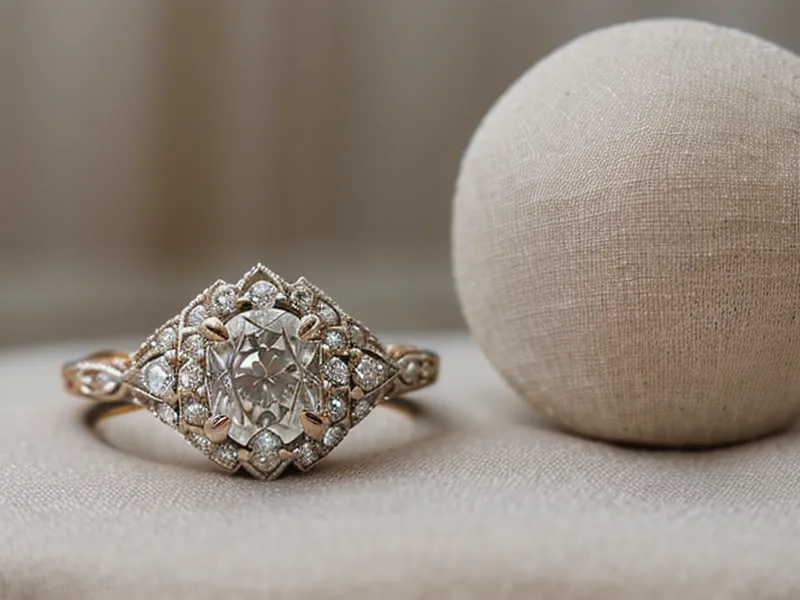
My thumb is already three photos deep into a Ross-Simons estate listing before I even register what I'm looking at: an Art Deco band, geometric as a subway grate, diamonds set flush into the metal instead of propped above it. A friend sent me the link an hour earlier from a boutique downtown, where she'd been standing in front of the real thing with a price tag that made her laugh the wrong kind of laugh. That's usually how this starts: someone falls for a ring, finds out what it costs new, and calls the friend who treated her own engagement ring search like a used-car negotiation. For a vintage engagement ring look without paying new-ring prices, Ross-Simons' estate jewelry section is where I point people now — it's really a diamond buying guide disguised as one specific ring's paperwork.
She's not a ditherer by nature. She teaches spin classes at a small fitness studio a few blocks from her office and makes fast calls for a living, forty-five minutes at a time, but engagement rings short-circuit that instinct in almost everybody. So I told her to close that tab and open the estate section instead — same era, same craftsmanship, priced like something somebody already owned, because that's exactly what it is. Buying this way also means buying sight unseen, which is a different trust exercise than standing in a showroom: you give up the in-person handling, but you get time to actually think without anyone hovering.
'Estate' Is an Industry Term, Not a Compliment
Say 'vintage' out loud in a showroom and watch a salesperson's eyes light up. 'Estate' is the industry's catch-all for anything previously owned — a three-year-old trade-in sits in the same bucket as a genuine antique, and the only real line between the two is age. A piece needs a hundred years on it before anyone can call it antique with a straight face. Everything younger is just estate, whether it's from 1975 or 1925.
Ross-Simons has been buying and reselling jewelry since 1952, first out of Rhode Island, and that much time in the business means their estate inventory turns over constantly. For my friend, that volume was the opening. We weren't hunting for a new ring dressed up to look old — we wanted an old ring priced like it needed to move. Picture the difference between a brand-new 'retro' fridge and a mint mid-century original sitting in a warehouse sale: same look, completely different math.
Estate Savings vs. Mall Chain Markup
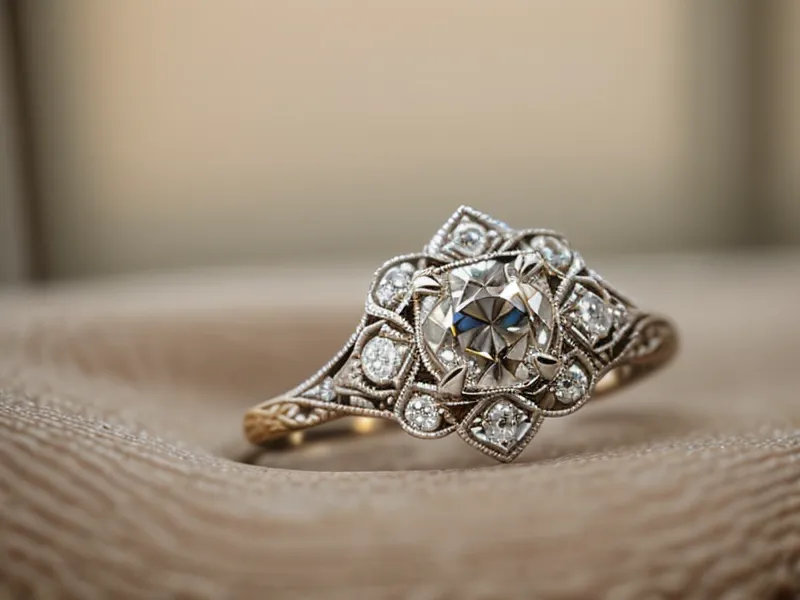
We didn't do this in one weekend. It stretched over a couple of months, most of it late at night with two laptops open, and I pulled up spreadsheets from my own ring hunt a while back comparing transition-cut diamonds — the actual antique shape mall chains only imitate now — against the round brilliants stuffed into 'vintage inspired' collections at the mall. Estate cuts like transition or old mine don't follow the same proportion charts jewelers use for modern fancy shapes like ovals, so comparing them by eye tells you more than comparing them by spec sheet.
Ross-Simons plays a volume game, not a boutique one, and that shows up two ways. The upside is price: a genuine mid-century piece can run meaningfully cheaper than a comparable new ring at a mall chain, because you're not paying for showroom lighting, in-house financing plans, and staff commission baked into the sticker. The downside is that you become the detective. You're zoomed into a photo of a 1950s cocktail ring trying to tell if the milgrain edging is worn soft from seventy years on someone's hand or filed down because the setting's been rebuilt, and there's no salesperson standing next to you to ask.
Some of that late-night squinting turned into daytime walking, looping the path around Hampton Park with my phone out, pulling up listings between laps while she talked through which one she couldn't stop thinking about. It's a strange kind of research date, but it's easier to judge a ring honestly when you're not standing under a store's lighting rig.
This is usually where I get asked the same handful of questions. Should she just go lab-grown for the same size and a friendlier price, skipping the back-and-forth entirely? Would moissanite get her most of the look for a fraction of the wondering? Would it be simpler to skip searching altogether and have something custom-built from scratch? All three are legitimate paths, and none of them were the one we were on. We wanted a stone and a setting that had already lived a life before it reached her finger, not a lab certificate with yesterday's date on it.
Does a 'Refreshed' Vintage Ring Still Count?
Here's my case against Ross-Simons, and it's a real one. Because they process so much estate inventory, they refresh pieces to sell better to people who don't want anything that looks like it needs work. I've watched them swap a worn-thin original shank for a bright, high-polish replacement band, or drop a modern laser-drilled diamond into a genuinely old mounting.
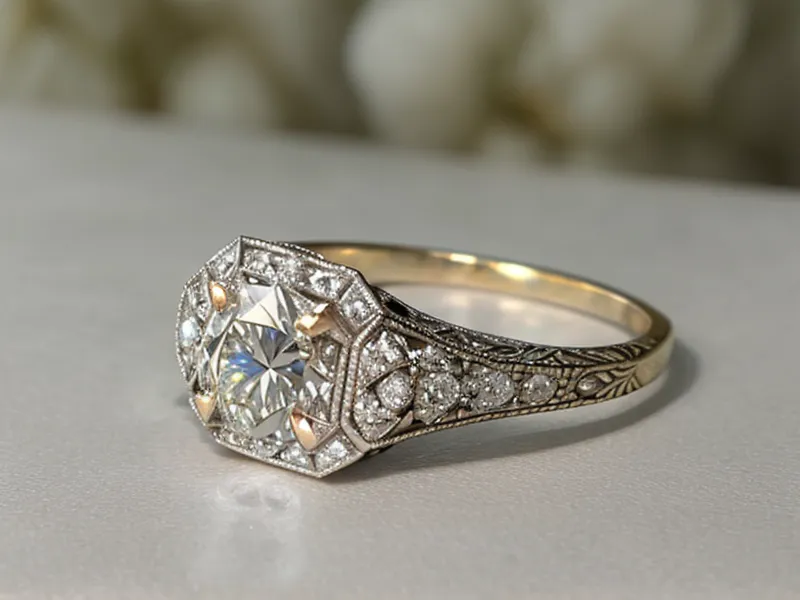
That trades provenance for wearability. If you want something closer to a museum piece, a refreshed ring will bother you. If you're like my friend and you're after the look and the weight of an older piece without paying boutique prices, that trade might be one you're fine making. Vintage-style settings with fine millegrain detail also wear differently day to day than a plain modern solitaire — the detail is more delicate, so it's worth having that daily-wear conversation with yourself before falling for a setting that photographs beautifully but needs babying at the sink.
None of this replaces the basic 4Cs conversation — cut, color, clarity, carat — but estate shopping adds a fifth thing to weigh: how much of the original piece is actually still original. I tell every friend to read the condition report instead of skimming past it. If it's vague, that's your excuse to call and ask the uncomfortable questions: is there a GIA report for the stone, is the setting original, has it been rhodium-plated recently to look shinier in photos than it will in six months.
The 30-Day Return Window Is Your Real Leverage
The only reason I'm comfortable recommending an estate purchase you haven't touched is the return window, and Ross-Simons gives you thirty days, the bare minimum I'd accept for something this expensive. That window is leverage, not just a safety net. It's your chance at a second, unbiased opinion before the sale is final, from someone with no stake in whether you keep the ring.
In my world, that clock starts the moment the box lands on the porch. We don't let a ring get worn around for a few days to 'see how it feels.' It goes straight to a local bench jeweler — not a salesperson, the person who actually repairs jewelry for a living — to check the prongs and confirm the stone isn't loose. Comparing Zales vs Kay Jewelers Policies Before You Buy a Ring shows how much more restrictive some chains get around anything marked 'used' or 'outlet;' this also isn't a trade-in situation; some retailers let you upgrade a stone later and roll the price forward, but estate pieces don't usually come with that kind of ladder built in, so what you buy is what you're committing to. It's also worth getting a piece insured the day it's appraised rather than the day it officially becomes yours, since a shipping mishap doesn't wait for a wedding date.
Reading the Condition Report Before You Buy
I'll admit what I almost got wrong here. Ross-Simons grades estate pieces on a scale — 'Excellent,' 'Very Good,' and so on — and the first time I saw 'Very Good' instead of 'Excellent' on a piece my friend liked, I assumed it meant something structural: a loose stone, a cracked prong. It didn't. It just meant surface wear the camera hadn't caught, the kind you'd expect from a ring that's spent decades on someone's hand. Treat these grades the way you'd treat a stranger's description of a 'clean' used car: probably true, definitely worth checking yourself. Under all that surface wear, some 'Very Good' pieces turn out closer to 'Excellent' than the photos suggested, which is part of why knowing How to Clean Your Ross Simons Jewelry at Home Without Damaging Stones matters before you write off a ring the camera didn't do justice.
Before I trusted myself to read any of this, I spent an evening watching jewelers' own YouTube channels walk through 'how to read your grading report,' figuring free education straight from the source would get me there faster. It didn't. Every video circled back to why their in-house grading was more trustworthy than the next guy's, which is a sales pitch wearing a tutorial's clothes. What actually worked was pulling up a real GIA report next to the listing and sitting with it until the layout stopped looking like a foreign language.
By the tenth week of doing that, I could open one of those reports and go straight to the clarity plot — that grid of tiny marks showing exactly where the inclusions sit — without needing a glossary open in another tab. Some estate pieces carry older GIA paperwork; some carry newer certificates from IGI instead, and the two labs don't always land on the same grade for the same stone, which is worth knowing before you compare two reports side by side and assume they're speaking the same language.
What the Bench Jeweler Found
When her ring finally arrived, there was no champagne-and-reveal moment. She'd already sized her own finger at home with a strip of paper and a printable chart before it ever shipped, so a small adjustment later wasn't a surprise. Lifting it out of the little velvet tray it came packed in, the nap caught against the band for a second, that tiny drag before a ring actually comes free of the fabric, and that was the moment it stopped being a photo on a listing page and started being an actual ring.
We took it to a small independent shop, unaffiliated with the sale, where the jeweler tilted the setting under a light and gave the prongs a gentle tap. The setting was authentic, late 1930s. The side stones, though, had been replaced sometime in the eighties, not what the listing led us to expect, but not a dealbreaker once we understood what we were actually looking at.
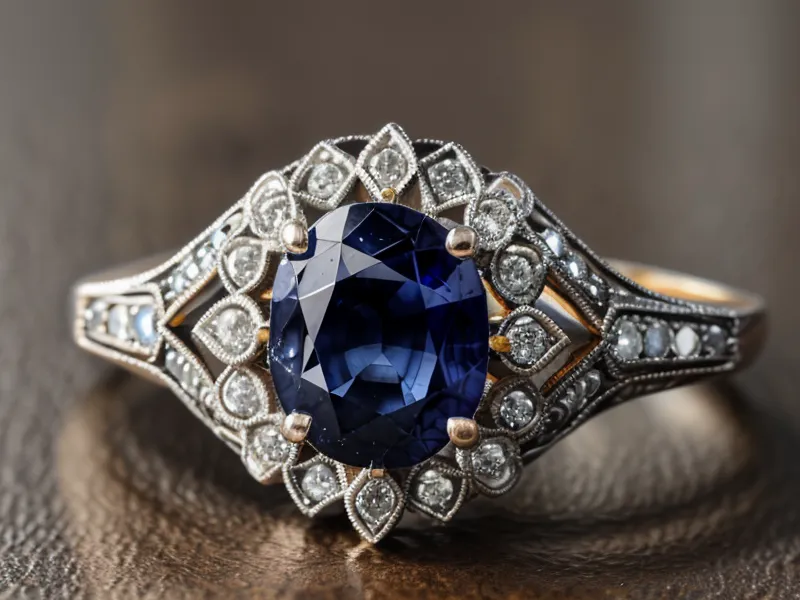
It wasn't flawless. It was real, though, and it had a weight that the mall's version of 'vintage-style' never manages: something that survived instead of something built to look like it did. Going the estate route instead of buying new left enough room in the budget to have that same bench jeweler reinforce the platinum prongs before she wore it every day, which mattered more to me than whatever we saved on paper.
Buying estate at a place like this trades a salesperson's script for your own homework, and most people aren't used to shopping that way for something this significant. The lesson I keep repeating to friends isn't really about Ross-Simons: it's that the return window is the only real protection you have on a piece you can't hold before you buy, so use every day of it, and don't let anyone, including your own excitement, talk you out of the bench-jeweler visit before that window closes. A ring with real history is worth chasing, but only if you check the history instead of just trusting the photos it came with.