The first time a jeweler slid a GIA report across the counter at me, I nodded along like I understood every line of it. I didn't. Rows of letters and numbers — cut, color, clarity, carat — and I was quietly trying to work out whether the price on the tag made any sense, from a document that doesn't mention price anywhere on it. I went home and started writing definitions in the margins of an actual legal pad (my partner still brings this up, unprompted, at dinner). This page is that legal pad, cleaned up: what each of the 4Cs terms actually means, so you're not standing in a showroom nodding at things you can't read either.
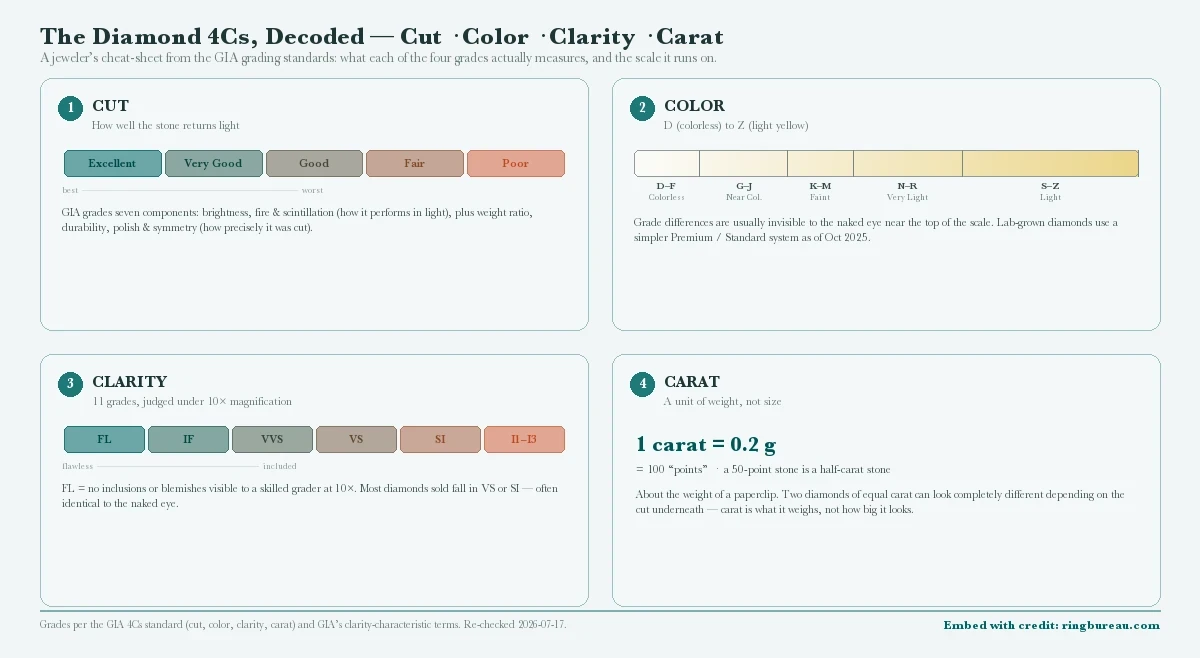
Diamond Cut and Light Performance
Cut is the one where showroom lighting matters more than anyone tells you upfront. At the mall chain, the salesperson dimmed the overhead lights the second I asked to look at a stone under the loupe — I didn't clock why until I compared notes with a friend later. Cut grade comes down to how well a diamond's facets bounce light back at you, and per the GIA, it's assessed across seven components: three about how the stone actually performs in light, and four about how precisely it was cut and finished. I couldn't tell you the difference between an Excellent and a Very Good by staring at a certificate. Standing under normal room lighting, not a jeweler's spotlight, I absolutely could.
| Grade/Term | Description |
|---|---|
| Excellent | Very bright, with an even pattern and strong contrast between light and dark areas; reflections read crisp and well-balanced (GIA). |
| Very Good | High light return; appears slightly darker at the edges or has minor proportion variations. |
| Good | Reflects much of the light that enters, but lacks the brilliance of higher grades. |
| Fair | Light easily escapes through the sides or bottom, reducing the overall sparkle. |
| Poor | Proportions allow most light to escape, resulting in a dull or "leaky" appearance. |
| Brightness | The effect of all of a diamond's internal and external reflections of white light, best observed under diffused lighting (GIA). |
| Fire | What happens when white light traveling through the diamond disperses into its rainbow of spectral colors (GIA). |
| Scintillation | A combination of sparkle (flashes of light as the stone, the wearer, or the light source moves) and pattern (the arrangement and contrast of bright and dark areas) (GIA). |
Diamond Color Scale (D-to-Z)
Color is the grade everyone fixates on, and it's also where a salesperson at Kay pushed hardest — walked me from a J up toward a G "because you'll notice the tint," without ever actually holding two stones side by side so I could see what he meant. I bailed on that store the same afternoon. The GIA scale runs from D, completely colorless, down through the alphabet to Z, which carries a visible yellow or brown cast. Think of it like optioning up a used car — the top trim costs real money, and most people are perfectly happy two or three trims down once someone actually shows them the difference instead of just naming a letter. (As of October 2025, GIA also grades lab-grown diamonds on a simpler Premium-or-Standard system instead of running them through the full letter scale — one more thing nobody explained to me until I asked twice.)
| Category | GIA Grades | Visual Characteristics |
|---|---|---|
| Colorless | D, E, F | The rarest and most expensive tier; differences from one grade to the next are typically visible only to a trained grader under magnification, not to the naked eye (Rare Carat). |
| Near Colorless | G, H, I, J | Color is generally undetectable to the untrained eye, though slight tints may be visible when compared side-by-side with higher grades. |
| Faint | K, L, M | A faint yellow or brown tint is often visible to the naked eye. |
| Very Light | N, O, P, Q, R | Noticeable color tint, typically yellow or brownish. |
| Light | S, T, U, V, W, X, Y, Z | Obvious color tint; however, these do not qualify as "Fancy" colored diamonds. |
Diamond Clarity Scale
Clarity is the one I almost got wrong. I spent an embarrassing stretch of my search convinced a Flawless stone would obviously look better than an SI1 sitting right next to it — it won't, not to your actual eye, not without a loupe and someone pointing at the exact spot. By the third showroom I could see the upsell script coming: the pause right after "let me show you our nicer options," timed for whichever grade cost more. The GIA Clarity Scale runs 11 grades, from Flawless down to Included, all judged under a jeweler's loupe at 10x magnification — the kind of magnification where you're squinting to find whatever the salesperson is pointing at. A stone one grade down that looks identical to your eye can run a couple hundred cheaper, which is the whole reason I started asking to see the actual GIA report before I asked about anything else.
| Grade | Definition |
|---|---|
| Flawless (FL) | No inclusions or blemishes visible to a skilled grader under 10x magnification (GIA). |
| Internally Flawless (IF) | No inclusions visible under 10x magnification; only minor surface blemishes. |
| VVS1, VVS2 | Very, Very Slightly Included; inclusions are difficult for a skilled grader to see under 10x magnification (GIA). |
| VS1, VS2 | Very Slightly Included; inclusions are minor and range from difficult to somewhat easy for a skilled grader to see under 10x magnification. |
| SI1, SI2 | Slightly Included; inclusions are noticeable to a skilled grader under 10x magnification. |
| I1, I2, I3 | Included; inclusions are obvious under 10x magnification and may affect transparency and brilliance (GIA). |
Carat Weight and Inclusion Glossary
Carat is the number people say out loud at parties, and it's the one most disconnected from what a diamond actually looks like on a hand — kind of like how the square footage on an apartment listing tells you almost nothing about whether a place feels bigger once you're standing in it. A carat is a unit of weight, not size: 0.2 grams, split into 100 "points," so a 50-point stone is a half-carat stone. Two diamonds can weigh the exact same amount and look completely different depending on the cut underneath — which is the whole reason I made my partner sit through comparison photos of stones at "identical" weights (he found this excessive; I regret nothing). Below are the actual terms you'll hear if you ask to see a diamond's inclusions under magnification — the vocabulary I wish I'd had before I nodded along in three different showrooms pretending I already did.
- Carat (ct)
- A unit of mass equal to 0.2 grams, about the same weight as a paperclip. Each carat is divided into 100 "points," so a 50-point stone is a half-carat stone (GIA).
- Cloud
- A cluster of smaller inclusions grouped in one area; individually too small to be readily visible, but together they read as a hazy, less distinct patch (Serendipity Diamonds).
- Feather
- A break or fracture inside the stone, often white and wispy; in higher-clarity diamonds it can be difficult to see even under 10x magnification (Serendipity Diamonds).
- Needle
- A thin, elongated, needle-shaped inclusion that can vary in length (Serendipity Diamonds).
- Pinpoint
- A very small, dot-like inclusion; the most common type of inclusion in a diamond (Serendipity Diamonds).
- Twinning Wisp
- A series of pinpoints, clouds, or crystals that form along a diamond's growth plane, tied to crystal distortion and twinning planes during formation (Serendipity Diamonds).
I still keep a version of this taped inside a kitchen cabinet. If you're mid-search right now, bring a notepad — you will not remember any of this by showroom three.
Last verified: 2026-07-17
Sources
- GIA: Diamond Cut Quality Factors
- GIA: Diamond Cut Grading Basics
- GIA: Diamond Color Scale
- Whiteflash: GIA's 2025 Lab-Grown Diamond Grading Update
- Rare Carat: Diamond Color Grading Chart and Scale
- GIA: Diamond Clarity Scale
- GIA: Diamond Carat Weight
- Serendipity Diamonds: Clarity Characteristics of Diamonds