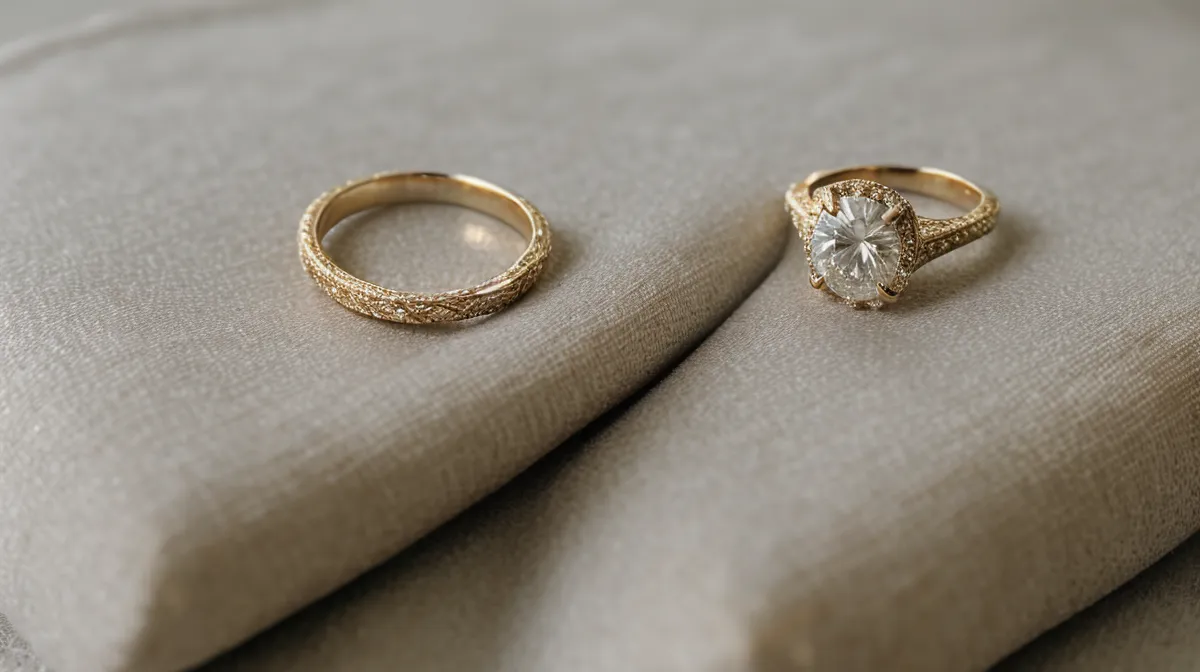
How do you land on an accurate ring size for a man who has no idea you're already deep in proposal planning? It's the question I get almost as often as the one about mall markups, usually texted at odd hours by someone convinced they've already blown the surprise.
Every version of this advice you'll find online skips past the one fact that actually decides which method works: whether he already wears a ring you can borrow for an hour. That detail splits this part of engagement prep into two different situations, and treating them the same is where most of the guesswork, and most of the resizing fees, comes from.
Why Sleep Measurements Lie
The internet's favorite trick is looping a piece of string or dental floss around his finger while he's asleep. It sounds foolproof. He's unconscious, you're quiet, nobody suspects a thing. It also hands you the least reliable number you'll collect during this whole process. Every time.
Hands swell overnight. Circulation slows and positioning shifts, so a finger measured at midnight can read a half size bigger than that same finger reads at ten the next morning. A ring has to fit the hand he actually lives in — upright, awake, normal temperature — not a hand that's been flat on a mattress for eight hours.
None of this means a sleep measurement is useless in every situation. If you genuinely have no other option and nobody else to enlist, a loose string measurement taken at a normal hour, early evening after he's been up and moving for a while, beats no data at all. Just don't trust a number pulled from 2 a.m.
The Math Behind DIY Ring Sizing
Ring size charts look forgiving until you actually measure the gap between two consecutive sizes. A US size 6 ring has an inner diameter of 16.5 millimeters. A size 7 measures 17.3. That's under a millimeter separating two whole sizes people wear every day, and to the naked eye they look identical.
That's the entire argument for measuring carefully instead of eyeballing it. The standard jump between full sizes is one whole size, but plenty of jewelers actually work in half and quarter increments, precisely because that top-line number hides so much. You don't get to guess here and hope it works out.
When He Already Wears a Ring
If he already wears a ring on the correct finger, the one he'd actually wear a wedding band on and not some other finger where the size runs completely differently, you're in the easier of the two situations. Don't measure it with a ruler. Trace it instead.
Get a sharp pencil and a plain sheet of paper, then trace the inside edge of the ring three separate times to make sure your hand didn't slip on any one pass. That tracing becomes a template a jeweler can measure precisely, which beats eyeballing a plastic ruler against a curved edge every time. When I was deep in my own research, I spent more hours than I'd like admitting on understanding the GIA diamond grading scale before I'd even worked out how a ring would stay on someone's finger. Jewelers can't read your mind. They size off the data you hand them, so a sloppy tracing gets you a sloppy fit.
Starting With Nothing to Trace
If he wears no rings at all, you're stuck with the string or floss method, and now the small mistakes matter even more. Pull it too tight and you've shaved off a quarter size. Leave it too loose and the eventual ring slides around like it belongs to someone else.
Two other variables change the number more than people expect. Hands run smallest in the morning and in the cold, so measuring after a humid afternoon down by Shem Creek reads differently than the same finger first thing on a chilly morning. There's also a dominant-hand effect: his dominant hand typically runs about half a size larger than the other, so if you're going off a rough read on his right hand for a ring meant for his left, knock that estimate back down.
Does the Return Policy Cover You?
No matter how careful the tracing or the string measurement, there's a real chance you land a half size off, which is exactly why the return policy matters more than most people budget for. US ring sizes run on a standardized numerical scale, and most chain jewelers will do at least one resize free within a window of thirty to sixty days after purchase. That window, and what conditions apply to it, varies a lot by retailer. Get it in writing before you pay, not after — the same way you'd want a lease renewal clause spelled out before you sign, not explained to you after the fact.
My neighbor Keturah, a floor down and the person who helped me carry boxes up three flights the week I moved in, is usually the first one to ask about the return policy the second I start telling a showroom story (she's had practice — I'm the friend who reads return policies aloud at brunch, whether anyone asked or not).
A neighbor a few blocks over, Otis, messaged me after seeing a jeweler review I'd posted in our building's neighborhood group. He'd been saving toward a ring for two years and spent eight months just researching before he bought anything, the most patient person I've walked through this whole process with. Sitting with him at one showroom, where the air got noticeably heavier the farther back you walked from the entrance, I nearly let a salesperson's "certified diamond specialist" badge close the conversation without asking what body actually issued it. Half the time that credential is an internal training program, not an outside certification. Now I ask every time.
Some of this comes down to which kind of retailer you're dealing with in the first place. When I sat down with my Jared vs. Kay comparison for another friend, the resizing terms were where the two chains actually diverged, more than anything about the rings themselves. A boutique jeweler might offer more flexible terms verbally and less of it in writing, so get the policy on paper regardless of where you're standing. There's a sharper way to use that same policy as leverage before you ever pay, but that's a rabbit hole for another day.
Picking the Method That Fits
Everything above collapses into one decision. If he already wears a ring you can get your hands on for an hour, trace it — it's the closest thing to a guarantee you'll get without tipping him off. If he doesn't, use the string method, but time it for a normal hour, account for the dominant-hand gap, and treat a written resize policy as part of the purchase instead of an afterthought. Either way, put the floss back in the bathroom once you're done. That part, at least, should stay a secret.