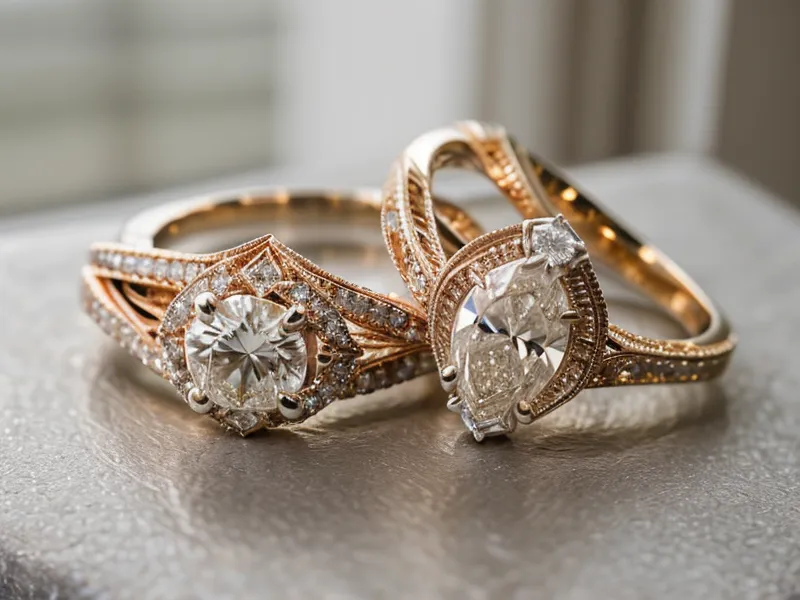
Kay Jewelers and Jared are owned by the same company. Most shoppers walk into either store without knowing that, and nobody behind the counter is going to bring it up first. I found it buried in the fine print of a financing disclosure during my own engagement ring search, and it's the first thing I tell anyone starting mall diamond shopping now. I've walked enough friends through the Kay-versus-Jared decision since then that the pitch has started to sound the same everywhere: same script, different chandelier.
Quick disclosure before we go further: some of the links below are affiliate links, and I earn a small commission if you click through and buy, at no extra cost to you. I only link to jewelers whose stores or sites I've actually spent real time researching during this comparison.
This round started with a friend of mine — she teaches spin classes at a boutique studio — texting me blurry showroom photos and asking, point blank, if she was getting upsold. That's basically my second job at this point.
Why a Mall Diamond Costs More Than the Stone Itself
Before we ever set foot in a mall together, we'd already burned through more research than either of us wanted to admit. Tracking everything from the Four Cs down to which stores would let you pull a stone from its setting for a second opinion became something of a habit. We looked at entry-tier options around $950 at Zales and crossed them off the list — the under-$1,000 stones we saw in person had inclusions visible without a loupe, which is not something you want to notice mid-pitch. We also priced out a $2,400 lab-grown solitaire from GOODSTONE, an online specialist with no physical showroom to walk into.
None of that explains why a diamond that costs roughly the same wholesale ends up priced so differently once it's sitting under mall lighting. That's the markup question worth understanding before you set foot in either store. A mall chain is paying for the real estate, the staffed showroom, the financing department that will offer to carry your balance before you've even picked a setting — and all of that gets folded into the sticker price before you see a single stone. An online specialist like GOODSTONE skips most of that overhead and prices closer to the stone's actual cost, though you give up trying it on. Neither approach is a scam. It's just math, and it's the reason a $1,200 mall solitaire and a $2,400 direct-to-consumer one can represent completely different value depending on what you're actually paying for — the stone, or the experience of buying it with someone walking you through financing.
Watching the diamond-education videos Kay and Jared publish on their own sites didn't help sort any of this out, for a fairly obvious reason: a tutorial made by the seller was never going to tell us the showroom lighting was doing some of the work.
The Ownership Fact Every Mall Jeweler Would Rather You Skip
Here's the detail that changes how you read both showrooms: Kay Jewelers and Jared are both owned by Signet Jewelers, and so is Zales. Same parent company, three different brands aimed at three different budgets. Their diamond sourcing programs, their in-house financing products, and their service warranty structures overlap far more than the separate storefronts let on. Kay leans into accessibility and a lower price floor, with a typical solitaire running around $1,200. Jared positions itself as the upscale sibling — it calls its stores a "Galleria" — with a standard solitaire closer to $1,800. But the paperwork behind the counter, the six-month inspection requirements, the upgrade language: that's coming from the same corporate playbook either way.
By the third store pitch of the week, we could finish the salesperson's sentence before they did. Every single one used the word "investment" at almost the exact same point in the conversation, like they'd all sat through identical training. That's not really a coincidence when two of your three options share a parent company.
Fixed Builds vs. Flexible Settings: Where the Two Actually Diverge
Price floor aside, the real difference between the two shows up once you start talking about settings. Kay's inventory is mostly what I'd call modular: you pick a ring that's already built, and if you want a different stone, they might swap it, but the setting itself stays fixed. Jared carries a much wider range of semi-mount options — the setting without a center stone — so you can pair a higher-carat solitaire with a mounting that wasn't originally sold as a set. Boutique-style sellers like Theo Grace work the same modular way Kay does, just online and at a lower price point, which tells you the fixed-build model isn't a mall-only habit.
Whether that flexibility is worth paying for depends on what your hand actually does day to day. A low-profile setting built to survive a gym bag or garden bed beats a tall halo that snags on everything, no matter how many showroom displays push the halo as the better-looking option. Anyone who already knows the exact head style they want should expect to pay Jared's higher entry price for the semi-mount range. Anyone fine with something pre-built gets there for less at Kay.
What Actually Changes Between the Two Showrooms
Sit through a demo at either store and the script bends toward the same handful of moves: the lifetime warranty pitch, the trade-in-for-a-bigger-stone promise, the financing plan walked through before a setting is even chosen. Jared's trade-in language sounds generous until you read what actually triggers it — you typically have to spend close to double the original price to cash it in, which is worth knowing before signing anything, not after. An $1,800 Jared stone isn't automatically better than a $2,400 lab-grown diamond from an online specialist like GOODSTONE. That's mall convenience and an in-person warranty weighed against a lower price for comparable specs, and it's a genuinely personal call rather than a universal answer.
Staff comfort discussing GIA reports was where Jared pulled ahead in our side-by-sides. Kay's team leaned harder on in-house grading, which is a bit like a student grading their own homework. A salesperson dropping "GIA" casually into a pitch is not the same thing as an independent report — that casual mention gave one friend false confidence right up until she sat down and actually read the document line by line, and the grading on paper didn't quite match what had been implied out loud. Ask for the actual report before the financing conversation starts, not after. Once you're mid-paperwork on a payment plan, nobody's pulling a tray back out of the case with that soft little suction pop the velvet ones make just so you can double-check a grade.
Four Mistakes That Cost People Real Money
I've made or watched every one of these happen up close, and they're worth naming plainly.
My own ring came back a size too small at first — the measurement was taken on a warm day with swollen fingers instead of at a counter with a proper mandrel, and even a "lifetime" resize policy still means weeks of waiting and sometimes a rush fee to fix it.
A return window nearly closed on a ring I was genuinely unsure about, next. The clock had started at the purchase date, not the pickup date, so by the time a resize came back from the workshop there was almost no time left to actually change course.
Paying extra for a cut grade one step above what the setting could even show off came after that — no visible difference to the eye or under a loupe, and a friend's fiancé made the identical call a year later for the identical reason: the salesperson made the upgrade sound mandatory when it was closer to optional.
Trusting an in-house appraisal over an independent report was the costliest one. The store's own paperwork was generous in exactly the ways that flattered the sale. Nobody catches that unless they ask for the actual GIA report and sit down and read it, which turned out to be the one habit that would have saved money on more than one of these.
Making Your Choice
Boiled down, the choice is about how much you value the build versus the price floor. Go with Kay Jewelers if your budget sits under roughly $1,500 and a classic, pre-set ring works fine — with over a thousand stores nationwide, resizing or cleaning is easy almost anywhere you move. Go with Jared if the higher-carat look and semi-mount flexibility matter more than the entry price, since the $1,800 starting point buys better-graded stones and an actual say in how the setting comes together.
My verdict for my friend, once we'd walked both stores twice, was that Jared didn't feel like a compromise the way Kay sometimes did — but only if she went in ready to push back on the trade-in pitch and ask for the GIA report before financing came up. Bring a spreadsheet if that's your style, or just bring someone willing to ask about the return window mid-sentence. If you want to see the stone quality difference for yourself, checking out Jared's current solitaire selection is a better starting point than either of the other two — just get the GIA report in hand before anyone mentions financing.